


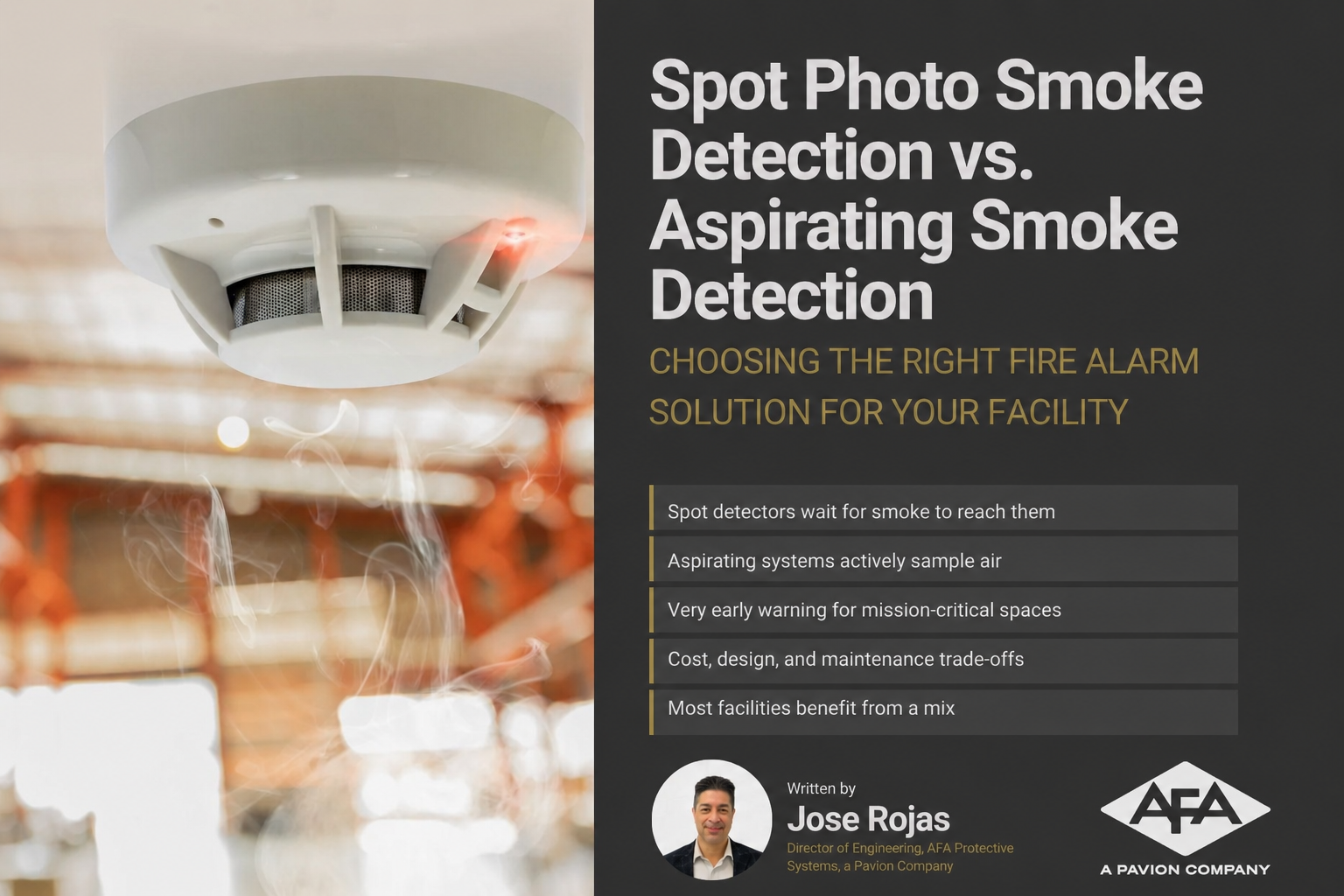
Expert Insight from Jose Rojas, Director of Engineering
Written by Jose Rojas, Director of Engineering, AFA Protective Systems, a Pavion Company
When it comes to commercial fire alarm system design, smoke detection is not one-size-fits-all. The right solution depends on the building, its risk profile, environmental conditions, required response time, and the operational impact of downtime or nuisance alarms.
Two commonly considered technologies are spot photo smoke detection and aspirating smoke detection (ASD), also known as air-sampling smoke detection. Both are designed to detect smoke, but they operate in very different ways.
Understanding the differences between spot photo smoke detection vs. aspirating smoke detection can help facility managers, engineers, property managers, and safety professionals determine which technology may be best suited for their facility.
Spot photo smoke detectors are widely used throughout commercial buildings and are generally well suited for standard environments. Aspirating smoke detection systems actively draw air through a network of pipes and analyze it for smoke particles, making them a strong option for environments where earlier warning, high sensitivity, or challenging access conditions are important.
Need help choosing the right smoke detection solution? Contact AFA Protective Systems to speak with our fire alarm experts.
What Is Spot Photo Smoke Detection?
A spot photo smoke detector is a ceiling- or wall-mounted device that uses photoelectric technology to identify smoke particles in the air. Photoelectric smoke detection is generally more responsive to smoldering fires, which often produce visible smoke before flames develop.
These devices are called “spot” detectors because each detector protects a specific area or location.
In many commercial fire alarm systems, multiple spot smoke detectors are installed throughout:
- Corridors
- Offices
- Rooms
- Storage areas
- Common spaces
- Other designated areas requiring smoke detection
Advantages of Spot Photo Smoke Detection
Cost-Effective for Standard Commercial Applications
Spot photo smoke detectors are often a practical and cost-effective solution for typical commercial environments, including:
- Offices
- Schools
- Retail spaces
- Healthcare support areas
- Multifamily buildings
- Other standard commercial facilities
Because these devices are straightforward to install and widely understood by fire alarm professionals, they can support efficient system design, testing, and maintenance.
Simple Installation and Familiar Technology
Spot smoke detectors are familiar to facility teams, inspectors, contractors, and authorities having jurisdiction.
Their installation requirements are well established, and troubleshooting is typically straightforward.
For many facilities, this makes spot photo smoke detection a dependable baseline solution.
Reliable Performance in Standard Ceiling Heights
In spaces with standard ceiling heights and stable airflow conditions, spot photo smoke detectors can provide reliable smoke detection.
They are particularly appropriate in areas where smoke can naturally rise and reach the detector without significant delay or obstruction.
Device-Level Identification
Addressable spot smoke detectors can identify the specific device that has entered an alarm condition.
This can help facility personnel and first responders locate the area of concern more quickly.
Disadvantages of Spot Photo Smoke Detection
Detection Depends on Smoke Reaching the Device
Spot detectors are passive devices. They do not actively pull air into the detector from throughout the protected space.
Smoke must physically reach the detector’s sensing chamber.
In environments with high ceilings, unusual airflow, large open volumes, or significant HVAC air movement, smoke may stratify, dilute, or take longer to reach a spot detector.
Access Can Be Difficult
Spot detectors located in high ceilings, atriums, warehouses, elevator machine rooms, cleanrooms, or other difficult-to-access areas can make inspection, testing, and maintenance more complicated.
Servicing these devices may require:
- Lifts or specialized equipment
- Additional access coordination
- Temporary operational downtime
- Work outside normal business hours
Less Ideal for Very Early Warning Applications
Spot photo smoke detection is effective for many life safety applications, but it may not provide the earliest possible warning in environments where even a small amount of smoke could cause significant disruption.
Facilities that may benefit from earlier detection include:
- Data centers
- Telecommunications spaces
- Museums and archives
- Laboratories
- Manufacturing environments
- High-value storage facilities
- Mission-critical infrastructure
In these environments, earlier detection may allow facility teams to investigate and respond before a situation escalates.
What Is Aspirating Smoke Detection?
Aspirating smoke detection, or ASD, uses a network of sampling pipes installed throughout a protected area.
A fan continuously draws air through the pipe network and delivers it to a detection chamber, where the air is analyzed for smoke particles.
This active air-sampling approach can provide very early warning of a potential fire condition.
Many aspirating smoke detection systems also offer multiple alarm thresholds. These thresholds may allow facility teams to receive an early alert, investigate the issue, and respond before a full fire alarm condition occurs.
Aspirating smoke detection is often used in facilities where business continuity, asset protection, and early intervention are critical.
Advantages of Aspirating Smoke Detection
Very Early Smoke Detection
One of the primary advantages of aspirating smoke detection is its sensitivity.
ASD systems can identify smoke at very low concentrations, often before smoke is visible to building occupants.
Aspirating smoke detection may be valuable in environments such as:
- Data centers
- Healthcare facilities
- Cleanrooms
- Telecommunications rooms
- Control rooms
- Museums and archives
- Warehouses
- Cold-storage facilities
- High-ceiling spaces
- Mission-critical facilities
Earlier warning gives facility teams additional time to investigate, isolate the source, protect critical assets, and potentially reduce operational disruption.
Strong Performance in Challenging Environments
Aspirating smoke detection can be a strong solution in areas where traditional spot detection may be difficult to apply, including spaces with:
- High ceilings
- High airflow
- Limited access
- Sensitive equipment
- Large open volumes
- Complex room geometry
Because ASD systems actively sample air, they can be designed to account for airflow patterns, environmental conditions, and facility-specific risks more strategically than a standard spot detector layout.
Centralized Testing and Maintenance
With an aspirating smoke detection system, the central detector unit can often be installed in an accessible location while the sampling pipe network extends into difficult-to-reach areas.
This can simplify testing and maintenance in environments where ceiling access is limited, expensive, or disruptive.
For facilities with tall ceilings, secure areas, or continuous operations, centralized access can be a significant advantage.
Flexible Alarm Thresholds
Many aspirating smoke detection systems can be programmed with multiple alarm levels, such as:
- Alert
- Action
- Fire alarm
This can support a graduated response strategy.
Rather than waiting until smoke reaches a traditional fire alarm threshold, facility teams may receive an earlier warning that allows them to investigate before conditions worsen.
Supports Business Continuity
In facilities where downtime is costly, fire detection is not only a life safety consideration. It is also an operational resilience issue.
Aspirating smoke detection can help organizations identify potential fire conditions earlier, reduce response time, and protect critical operations from avoidable disruption.
Disadvantages of Aspirating Smoke Detection
Higher Initial Cost
Aspirating smoke detection systems typically have a higher upfront cost than standard spot photo smoke detectors.
An ASD installation may require:
- A central detector unit
- Sampling pipe network
- Multiple sampling points
- Power and system integration
- Programming and commissioning
- Specialized system design
For standard office or retail environments without elevated risks, ASD may be more advanced than the application requires.
More Complex Fire Alarm System Design
ASD performance depends heavily on proper system design.
Important considerations include:
- Pipe layout
- Sampling hole placement
- Smoke transport time
- Airflow patterns
- Room usage
- Environmental conditions
- System sensitivity
- Applicable codes and standards
Air-sampling ports may be treated similarly to spot-type detectors for location and spacing unless an approved performance-based design approach is used.
For this reason, aspirating smoke detection systems should be designed and installed by qualified fire alarm professionals who understand applicable requirements and the specific environment.
Ongoing Maintenance Requirements
Although ASD can simplify access in certain environments, it is not maintenance-free.
Sampling pipes, filters, airflow, and detector performance may require inspection and service.
Dust, debris, humidity, and environmental contaminants can affect system performance when the system is not properly maintained.
Not Necessary for Every Facility
For many standard commercial environments, spot photo smoke detection may provide appropriate coverage at a lower cost.
Using ASD where it is not necessary can increase system complexity without providing meaningful additional value.
The right solution should be based on the facility’s risk, environment, operational requirements, and applicable codes rather than simply selecting the most advanced technology available.
Spot Photo Smoke Detection vs. Aspirating Smoke Detection
| Category | Spot Photo Smoke Detection | Aspirating Smoke Detection |
|---|---|---|
| Detection Method | Passive detection at an individual device location | Active air sampling through a pipe network |
| Best Suited For | Standard commercial spaces | High-risk, high-value, or challenging environments |
| Early Warning | Appropriate for typical life safety applications | Very early warning capability |
| Initial Cost | Generally lower | Generally higher |
| Maintenance Access | Device-by-device access may be required | Central detector can often be installed in an accessible location |
| Design Complexity | Simpler and more familiar | More complex and application-specific |
| High Ceilings | May be less ideal depending on conditions | Often better suited when properly designed |
| Business Continuity | Appropriate for general protection | Strong option for mission-critical operations |
| Sensitivity | Standard smoke detection sensitivity | High-sensitivity detection options |
| Typical Applications | Offices, corridors, common areas, and standard rooms | Data centers, cleanrooms, warehouses, healthcare facilities, archives, telecommunications spaces, and high-airflow environments |
When Is Spot Photo Smoke Detection the Better Choice?
Spot photo smoke detection may be the right solution when:
- The building has standard ceiling heights.
- The environment is relatively clean and stable.
- Access for inspection and maintenance is manageable.
- The space does not require ultra-early smoke detection.
- Budget efficiency is a priority.
- The application is a standard commercial occupancy.
For many commercial buildings, spot photo smoke detection remains a reliable and practical solution.
When Is Aspirating Smoke Detection the Better Choice?
Aspirating smoke detection may be the better solution when:
- Early warning is critical.
- Downtime would be costly.
- The facility contains high-value equipment or assets.
- Ceiling access is difficult.
- The space has high ceilings or complex airflow.
- The environment is mission-critical.
- A phased response is needed before full alarm activation.
- The organization requires advanced detection for risk mitigation.
ASD can be particularly valuable in environments where even a relatively small fire event could have major consequences.
Can a Fire Alarm System Use Both Types of Smoke Detection?
Yes.
In many facilities, the right answer is not simply spot photo smoke detection or aspirating smoke detection.
The most effective fire alarm system may incorporate both technologies in different areas of the same facility.
For example, a building might use traditional spot photo smoke detectors throughout offices and corridors while installing aspirating smoke detection within a:
- Data center
- Equipment room
- Cleanroom
- Warehouse
- High-ceiling atrium
- Telecommunications space
The goal is not to overdesign or underdesign the fire alarm system. The goal is to match the detection technology to the risk and operating environment.
Why Expert Fire Alarm Design Matters
Smoke detection performance depends on more than the detector itself.
Effective fire alarm system design must consider the complete environment, including:
- Ceiling height
- Airflow
- Occupancy type
- Equipment and assets
- Maintenance access
- Business continuity requirements
- Applicable codes and standards
Working with a qualified commercial fire alarm professional is therefore critical.
An experienced fire alarm provider can evaluate the building, identify risks, coordinate with the authority having jurisdiction, and design a solution that supports both compliance and operational requirements.
Choosing the Right Commercial Smoke Detection Solution With AFA Protective Systems
AFA Protective Systems helps organizations evaluate, design, install, monitor, inspect, test, service, and maintain commercial fire alarm systems.
Whether a facility requires traditional spot photo smoke detection, aspirating smoke detection, or a combination of multiple detection technologies, the right fire alarm strategy should be based on the unique characteristics of the building.
AFA works with customers to develop fire alarm solutions designed around the facility’s risks, operational requirements, and long-term service needs.
Frequently Asked Questions About Spot and Aspirating Smoke Detection
What is the difference between spot smoke detection and aspirating smoke detection?
Spot smoke detection uses individual smoke detectors installed throughout a space. Smoke must physically reach the detector for the device to activate.
Aspirating smoke detection actively draws air through a sampling pipe network and analyzes it for smoke particles at a central detection unit.
Is aspirating smoke detection better than spot smoke detection?
Not necessarily.
Aspirating smoke detection may be better suited for applications where very early warning, high sensitivity, complex airflow, high ceilings, or difficult maintenance access are important.
Spot photo smoke detection is often the more practical choice for standard commercial spaces where environmental conditions are stable and advanced early warning is not required.
Where is aspirating smoke detection commonly used?
Aspirating smoke detection is commonly used in environments such as:
- Data centers
- Telecommunications rooms
- Cleanrooms
- Healthcare facilities
- Warehouses
- High-ceiling spaces
- Museums and archives
- Laboratories
- Mission-critical facilities
Is spot photo smoke detection reliable?
Yes. Spot photo smoke detection is a reliable and widely used technology for many commercial fire alarm applications.
It is particularly appropriate in standard environments where smoke can reach the detector without significant delay or obstruction.
Why does ceiling height matter for smoke detection?
Ceiling height affects how smoke travels and how quickly it reaches a detector.
In high-ceiling spaces, smoke may dilute, stratify, or take longer to reach a spot detector. Aspirating smoke detection may be considered in these environments when properly designed for the space.
Does aspirating smoke detection require maintenance?
Yes.
Aspirating smoke detection systems require regular inspection, testing, and maintenance. Sampling pipes, filters, airflow, and detector performance should be maintained in accordance with manufacturer requirements and applicable codes.
Can a commercial building use both spot and aspirating smoke detectors?
Yes. Many buildings use a combination of smoke detection technologies.
Spot photo smoke detectors may be used throughout standard areas, while aspirating smoke detection may be used in high-risk, high-value, mission-critical, or difficult-to-access spaces.
How do I know which smoke detection system my facility needs?
The best approach is to work with a qualified fire alarm professional.
A professional can evaluate factors such as the building’s risk profile, code requirements, ceiling heights, airflow conditions, maintenance requirements, equipment, and business continuity goals to recommend an appropriate detection strategy.
Protect Your Facility With the Right Fire Alarm Detection Strategy
Spot photo smoke detection and aspirating smoke detection both play important roles in modern commercial fire alarm system design.
Spot photo smoke detectors are cost-effective, familiar, and well suited for many standard commercial applications.
Aspirating smoke detection systems provide very early warning capabilities, flexible design options, and significant value in mission-critical or challenging environments.
Ultimately, the right choice depends on the space, its risk profile, environmental conditions, and the potential operational impact of a fire event.
By working with an experienced fire alarm professional, organizations can select a smoke detection strategy designed to support life safety, compliance, reliability, and business continuity.
Contact AFA Protective Systems today to discuss your commercial fire alarm and smoke detection needs.